
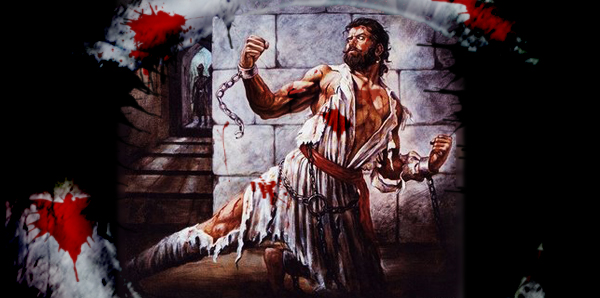
After the death of the great king Shivaji in 1680 the nascent Maratha kingdom faced a great challenge. The Moghul Emperor Aurungzeb had been confounded and defeated by the repeated battles with the Marathas and the high spirit of Shivaji. With the forces of fanaticism released throughout South Asia and to sustain himself the aged emperor leaned ever heavier on the clerics and upon religious exclusivism. The king of the Marathas with his slaying of the Afghan war leader, Afzal Khan, the daring attack on Shaista Khan and the escape from the very depths of the Mughal Empire in Delhi were the stuff of legend in the lifetime of Shivaji himself. The deaths of the great Rajput Chiefs, Jai Singh and Jaswant Singh around the same time seemed to open the floodgates of repression and extremism even further. Orders were issued to demolish the Hindu temples and impose the hated poll tax on non-Muslims – the jaziya.
As the empire groaned in its agony resistance began to multiply and grow leading to further repressions. The Bundelas in central India began fighting; the Jats of the Mathura region and the Rajput clans of the Rathores and Sisodiyas in Rajasthan even leading to a son of Aurangzeb named Akbar to join the Rajput’s. In fury the enraged Emperor led the main imperial army to crush his son and his erstwhile rebellion.
Further south the Mughals believed that the Marathas would be unable to repeat their exploits under the son of Shivaji, Shambaji thinking that the sustenance of this new Hindu kingdom rested on one able man alone. Like so many other rebellions in that period, he thought the Maratha movement too must have received its death blow with the passing of its able leader, and by the fact that Shivaji had been succeeded by his brave but incapable son, Sambhaji. Sambhaji had courage, which he indeed demonstrated on various occasions, but also indulged in excesses leading his father on occasion forced to consider a severe punishment for his own son. Sambhaji in his rage left and joined the Moghuls! This was an intensely painful time in Shivaji’s life. Sambhaji left the Moghuls and begged for forgiveness when he witnessed first-hand the atrocities against Hindus.
Shambaji offered refuge to Akbar and in 1682 the lost son of Aurangzeb escorted by the Rajput’s arrived in safety in Maharashtra. Close behind the Emperor entered the Maratha Kingdom in the same year. Few would have guessed that he would never return to the north spending the last 27 years of his life in a futile and eventually failed war with the Hindus.
The war was engaged and raged from this period onwards in a steady ebb and flow in the hills of western India with neither side able to emerge over the other. The steady courage of Shambaji was only matched by his impetuous and rash nature. Only his minister Kavi Kalash was able to exercise any control over the headstrong king. An equal measure of the rage of shamabji was directed towards any perceived rivals or dissenters in his kingdom and he dealt with the same with extreme severity and with all the rage for which he was justly famous.
Blood flowed over the mountains and the land was ruined but the people fought on. The full force of the empire was now borne down on the barren hills and the prime generals and troops of the Mughals now all entered into the fray. For seven years more that war continued with its monotonous tale of attack and counter attack – of determined sieges and equally determined sieges. Of forts falling to the Mughals only to be retaken months later and for the cycle of destruction to continue.
In 1689 however the situation changed. The Maratha king was at Sangameshwar unaware of the nearness of his enemies and with a scant force around him. After a sudden raid under Muqarrab Khan a Mughal force reached the place and after a bitter fight succeeded in capturing Shamabaji and Kavi Kalash.
The next chapter is best described in the words of the : Masir I Alambiri, the official history of Aurangzeb’s reign:
Shamba was brought before the court. The Emperor out of his devotion to Islam ordered that from four miles before the camp Shambha should be made an object of ridicule …..so that the Muslims might be encouraged and the Hindus discouraged by the sight. The night in the morning after which he was brought to the Court …in the joyous expectation of seeing the spectacle, and the day was like the day of Eid because all men, old and young went out to see such a scene of joy and happiness.The Emperor ordered that man to be removed to the prisons and in that moment Aurangzeb descended from the throne and kneeling down on the carpet of prayer bowed his head to the ground in thanksgiving and raised his hands in prayer to Allah….and drops of marvel(lit tears) fell from his far reaching eyes As the destruction of this wicked infidel in consideration of the harshness and disgrace that he had inflicted by slaying and imprisoning Muslims and plundering Muslims — and by the decision of the Doctors of the Law all were in favour of killing Shamba and thus he was killed with Kavi Kalash.After two days the Emperor ordered Ruhullah Khan to ask Shamba where he had kept his treasure . In these circumstances that haughty man opened his mouth in defiant and vain words about the Emperor (Aurangzeb) – So the Emperor ordered him to be blinded by driving nails into his two eyes -So it was done. But that proud man from his high spirit gave up taking food from that day onwards and continued to shout defiance to The emperor and the tenents of Islam.
Maratha sources report:
When they were brought face to face with Aurangzeb, the latter offered to let Sambhaji live if he surrendered all the Maratha forts, turned over all his hidden treasures and disclosed the names of all the Mughal officers who had helped him. Sambhaji refused, and instead sang the praises of Mahadev (Lord Shiva). Aurangzeb ordered him and Kavi Kalash to be tortured to death. Sambhaji and Kavi Kalash were brutally tortured for over a fortnight. The torture involved plucking out their eyes and tongue and pulling out their nails. The later part involved removing their skin. On March 11, 1689, Sambhaji was finally killed, reportedly by tearing him apart from the front and back with ‘Wagh Nakhe’ (‘Tiger claws’, a kind of weapon), and was beheaded with an axe. This grievous death was given to him at Vadhu on the banks of the Bhima river, near Pune.
From the Persian history (Fatuhat I Alamgiri) :
“At last the case was reported to the Emperor and by his order Shambaji was taken to the place of execution and his limbs were hacked of one after the other- his severed head was publicly exposed across the Empire and taken to Delhi and hung on the gate of that city”
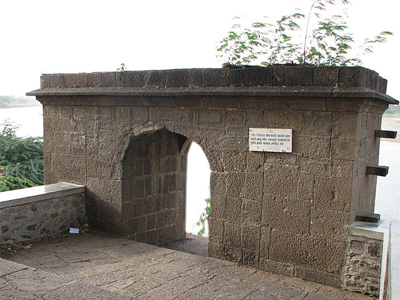 All accounts refer to days of horrific torture and agony which were borne with astonishing firmness and stoicism by Shambaji and his Brahmin minister Kavi Kalash. Even the purported offers of clemency on the public display of submission and/or an escape from the horror by conversion to Islam had little effect on the unfortunate Maratha king. After being blinded and his tongue cut from his mouth he surprisingly with great difficulty was still able to communicate and to continue to offer defiance to his oppressors.The memory of his inspirational father must have been close to Shambaji in the last days – given just sufficient time to rest between the tortures and removal of limbs after nearly two weeks of horrendous and unthinkable pain the broken and limbless king was executed – His head was cut off and placed in public display around the cities and towns of Maharashtra as a warning. But it did not have the desired effect.
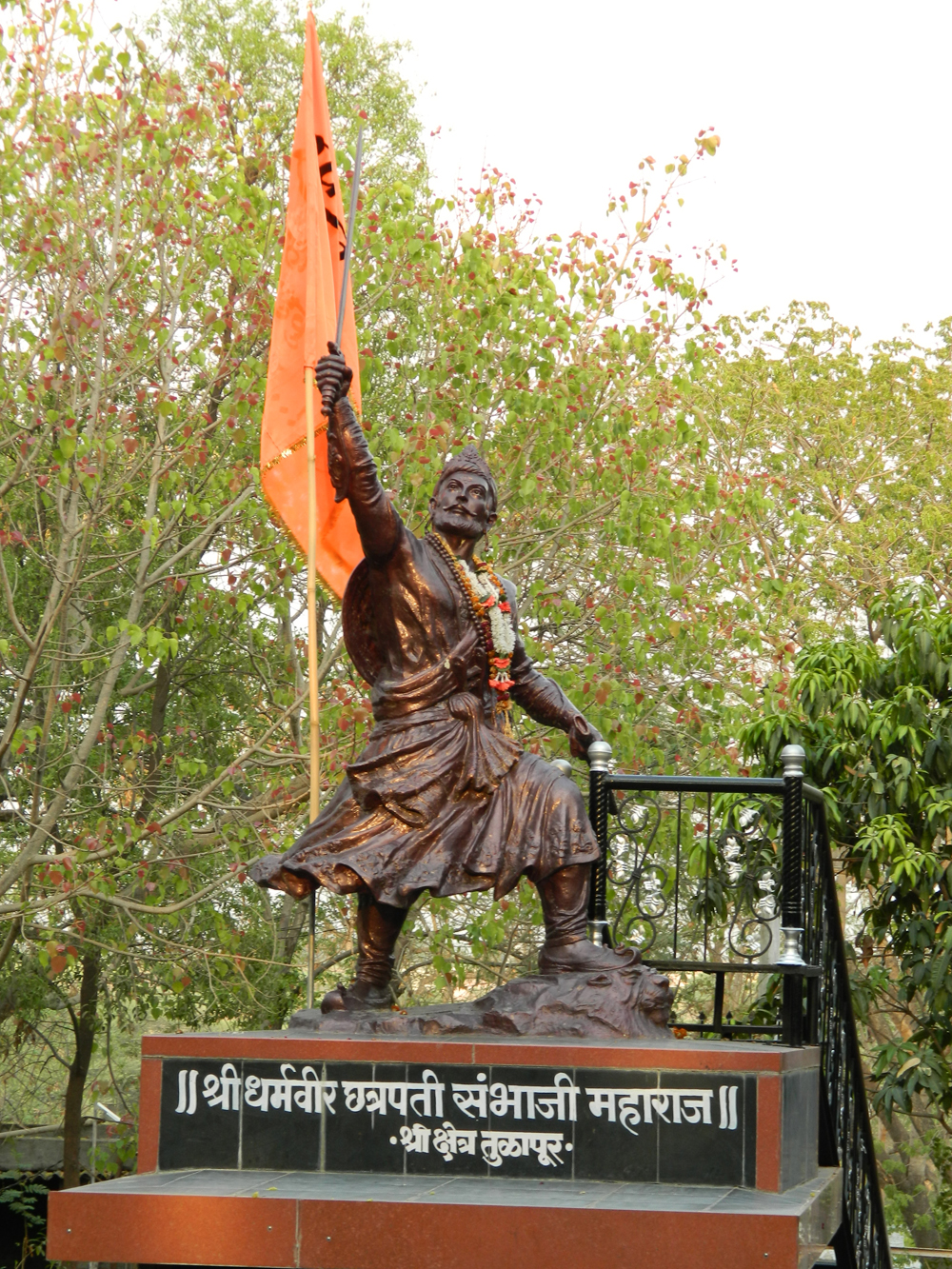
The news of the execution of the son of the much revered and loved king Shivaji send a wave of horror and revulsion throughout the land. His brother Rajaram took the crown and retreated to the great fortress of Jinji to endure a 10 year long siege by the Mughals. The excesses of Shamabji were forgotten – news of the method of his death and more importantly the accounts of the dead king spread like wildfire amongst the Marathas. For his adherence to the Hindu Dharma the people named him ‘Dharamveer’ the warrior of Dharma
In the moment of his apparent triumph Aurangzeb was beset by an even greater tide of enemies. The Marathas under their war bands and leaders took to fight all over the western and southern parts of India from coast to coast. Their soldiers everywhere continually harried and fought the Mughals in an even greater tidal wave of resistance. The harried and worn emperor continued to fight in the face of ever increasing odds. The peoples of the north of India began to rise in rebellions and struggles eventually leading to the destruction of the Mughals. For 27 long years Aurangzeb continued with his fight against the Marathas only to die in despair in 1707.
The son of Shivaji had redeemed the pledge of his father of Hindu Padshahi – His heroic death led to the eventual victory over the forces The Maratha Hindu empire rose on the ruins of the Mughals and a hundred years after the execution of Shambaji a defeated and blinded Mughal Padshah, Shah Alam fell at the feet and mercy of the Maratha warrior and kingmaker Mahadji Sindhia.
The dreams and inspirations of the great Hindu Monarch Shivaji echo through history as a lesson against the forces of fanaticism and prejudice.


 Within the Portuguese territories, physical persecution of Paganism naturally hit the Brahmins hardest. Treaties with Hindu kings had to stipulate explicitly that the Portuguese must not kill Brahmins. But in the case of Christian anti-Brahminism, these physical persecutions were a small matter compared to the systematic ideological and propagandistic attack on Brahminism, which has conditioned the views of many non-missionaries and has by now been amplified enormously because Secularists, Akalis, Marxists and Muslims have joined the chorus. In fact, apart from anti-Judaism, the anti-Brahmin campaign started by the missionaries is the biggest vilification campaign in world history (emphasis added).
 De Nobili’s approach was one possible application of the Jesuits larger strategy, which aimed at converting the elite in the hope that they would carry the masses with them. This approach had been tried in vain in China, in Japan, and even at the Moghul court (today, it is finally meeting with a measure of success in South Korea). A practical implication of this strategy was that Christianity had to be presented as a noble and elitist religion. This came naturally to the Jesuits, who (unlike, for instance, the Franciscans) styled themselves as an elite order.
 If the missionaries were sincerely unhappy with the institution of caste, it was not because of its intrinsic inequality. The problem with caste was that it offered a lot of communal togetherness, social security and a certain pride in one’s caste identity. Through the missionary propaganda, we have come to see caste as an exclusion-from, but in the first place it is a belonging-to [a community]. Even for the lowest castes, humiliation by higher placed people on account of caste did not outweigh the considerable benefits of belonging to at least some caste.
 It is therefore not true that the Church’s motivation in blackening the Brahmins had anything to do with a concern for equality. The Church was against equality in the first place, and even when equality became the irresistible fashion, the Church allowed caste inequality to continue wherever it considered it opportune to do so. As a missionary has admitted to me: in Goa, many churches still have separate doors for high-caste and low-caste people, and caste discrimination at many levels is still widespread. Commenting on the persistence of caste distinctions in the Church, a Dalit convert told me: I feel like a frog who has jumped from one muddy pool into another pool just as muddy.
 In the past century, the Churches one after another came around to the decision that the lower ranks of society should be made the prime target of conversion campaigns. Finding that the conversion of the high-caste people was not getting anywhere, they settled for the low-castes and tribals, and adapted their own image accordingly. One implication was that the Brahmins were no longer just the guardians of Paganism, but also the antipodes of the low-castes on the caste ladder. A totally new line of propaganda was launched: Brahmins were the oppressors of the low-caste people.
 Then again, the Aryan Invasion theory was the alpha and omega of the version of India history spread by anti-Brahminism.[5] Phule’s book Slavery starts out with this view of history: “Recent researches have shown beyond a shadow of a doubt that the Brahmins were not the Aborigines of India…. Aryans came to India not as simple emigrants with peaceful intentions of colonisation, but as conquerors. They appear to have been a race imbued with very high notions of self, extremely cunning, arrogant and bigoted.”
 Even among the champions of the Hindu cause, anti-Brahminism acquired a following. The Hindu reform movement Arya Samaj rejected Brahminism and its heretical brainchildren, idolatry and the caste system, as utterly non-Vedic. Brahmin temples were desecrated in the name of Hinduism. Orthodox Brahmins were attacked as the traitors of Hindu interests.
 Just as well, the missionaries knew whom to hold responsible for their failure: “The Brahmin is therefore well worth looking at! We have more to do with him than with the Czar of all the Russians. The battle we have to fight with him is not against guns or rifles, not against flesh and blood.” This assessment, written in a mood of vexation by Rev. Norman MacLeod in 1871, was comparatively mild next to what Abbe Dubois had written (and of which MacLeod approved) in 1820: “And there is no stronghold of evil so impregnable as Brahmins”.
 The concept of Cakravarti (“wheel-turner”, universal ruler) was in fact much older than Ashoka, and the 24-spoked wheel can also be read in other senses, e.g. the Sankhya philosophy’s worldview, with the central Purusha/Subject and the 24 elements of Prakrti/Nature. The anglicized Nehru, “India’s last Viceroy”, prided himself on his illiteracy in Hindu culture, so he didn’t know any of this, but was satisfied that these symbols could glorify Ashoka and belittle Hinduism, deemed a separate religion from which Ashoka had broken away by accepting Buddhism.
 At 29, he renounced society, but not Hinduism. Indeed, it is a typical thing among Hindus to exit from society, laying off your caste marks including your civil name. The Rg-Veda already describes the Muni-s as having matted hair and going about sky-clad: such are what we now know as Naga Sadhus. Asceticism was a recognized practice in Vedic society long before the Buddha. Yajnavalkya, the Upanishadic originator of the notion of Self, renounced life in society after a successful career as court priest and an equally happy family life with two wives. By leaving his family and renouncing his future in politics, the Buddha followed an existing tradition within Hindu society.
 On caste, we find him is full cooperation with existing caste society. Being an elitist, he mainly recruited among the upper castes, with over 40% Brahmins. These would later furnish all the great philosophers who made Buddhism synonymous with conceptual sophistication. Conversely, the Buddhist universities trained well-known non-Buddhist scientists such as the astronomer Aryabhata.
 Did he achieve this by saying that birth is unimportant, that “caste is bad” or that “caste doesn’t matter”, as the Ambedkarites claim? No, he reminded the king of the old view (then apparently in the process of being replaced with a stricter view) that caste was passed on exclusively in the paternal line. Among hybrids of horses and donkeys, the progeny of a horse stallion and a donkey mare whinnies, like its father, while the progeny of a donkey stallion and a horse mare brays, also like its father. So, in the oldest Upanishad, Satyakama Jabala is accepted by his Brahmins-only teacher because his father is deduced to be a Brahmin, regardless of his mother being a maid-servant. And similarly, king Prasenadi should accept his son as a Kshatriya, even though his mother was not a full-blooded Shakya Kshatriya.